

Where to get your independent journalism
15+ alternatives to traditional, for-profit media.

You’re reading Soft Hobbies, a weekly newsletter for artists in all mediums, with a special focus on writers. Here you’ll find resources to nurture your creativity, advice to overcome perfectionism, and inspiration to make time for art. I’m Auzin, a Seattle-based fiction and poetry writer. Feel free to visit my author website or check out my socials.
Greetings to the 1,479 softies who subscribe to this newsletter! Thank you for being here.
I did not grow up watching or reading the news. My parents tended to watch the news late at night or on weekend mornings, while I was preoccupied with homework or playing games on the family computer. I watched The Daily Show (and later The Colbert Report) with my family from late elementary school through early high school, but it was more for entertainment than information, and I didn’t understand the broader context of what was being discussed or satirized.
I don’t remember any of us reading print journalism on a regular basis, and I learned about big headlines from the homepage of msn.com right before I navigated to Neopets. The general impression I got about the news was “it’s always bad, it’s not relevant to you, and there’s nothing you can do about it.” As a kid who already had a difficult home life that I had no control over, there was little incentive to start reading daily about war and politics. Plus, it was boring.
On the bright side, that means I’m not attached to any of the traditional media institutions that are now becoming consolidated, disbanded, or billionaire-owned. But we’re all a part of this world. We deserve access to independent, free, ethical, well-researched journalism with the primary agenda of informing people, not controlling or selling to them.
The following is a list of 15+ sources to learn about the current state of the world. I’m not recommending you read all of them every day — that would be impossible — but maybe you can sign up for a few email newsletters or turn on notifications for a couple of them. Maybe you can set one as your homepage (do people care about homepages anymore?).
See which journalists have a writing style you connect with and which publications cover the issues you care about the most. I’ve included information about when each source was established, who owns the publication, and what topics are generally covered. Keep in mind that everything and everyone is biased; I don’t believe that unbiased journalism exists.
My friend Amanda Zhou, a climate reporter at The Seattle Times, had this to add:
My general advice is to read widely (not just one source) and if you can, find a way to get news outside of what algorithms serve you — through newsletters, website homepages, or directly following reporters you trust on specific topic.
Reading local is really important. Local politicians arguably have more of an impact on your day-to-day life than national politicians, and a lot of news at the city and state level is being depleted at the moment.
I think the news can definitely be a bummer and contribute towards doomerism, and I think it’s okay to take a break. But again, take this as an opportunity to stay grounded in local news, since these are issues that you CAN take action on with people in your community and CAN see change…Whatever issue you care about, I guarantee there is something happening at the local and state level that you can follow.
Thanks Amanda for the excellent advice. Make sure to follow her work! And make sure to support The Seattle Times union, who are bargaining right now with their management to receive fair wages and protection from replacement by AI. Keep up with them on their Instagram.
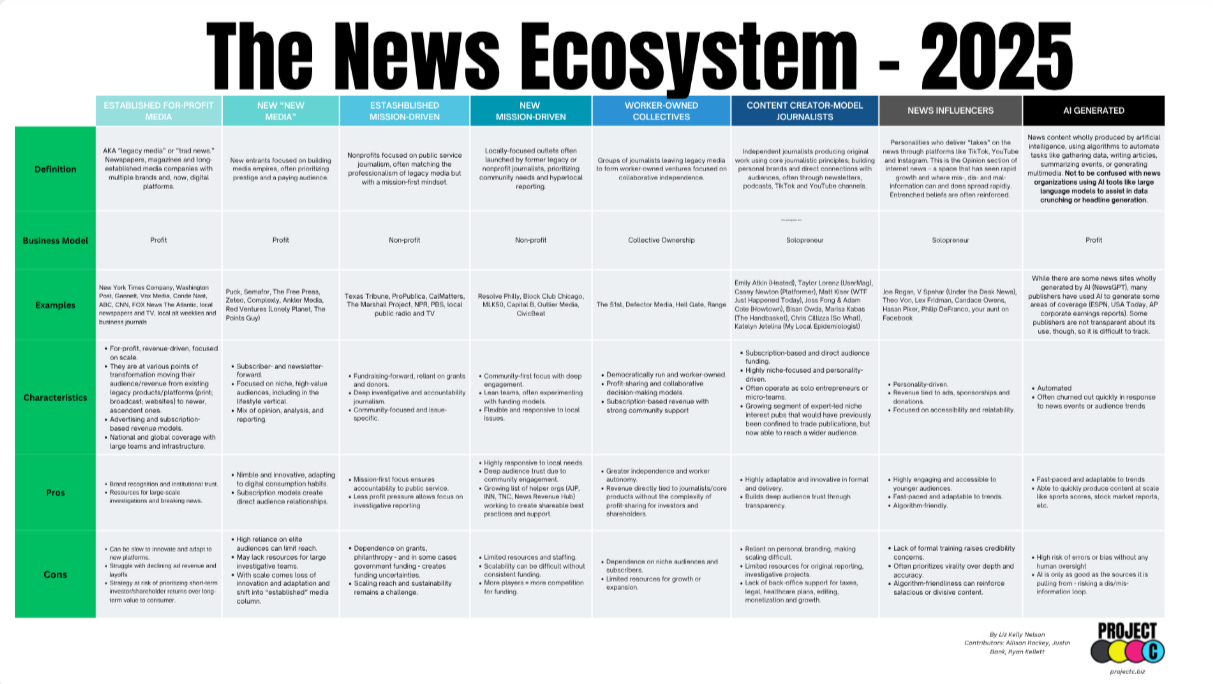
Amanda also shared this fantastic matrix that maps the current news ecosystem and can help you understand what kind of news you’ve been reading. I highly recommend taking a look.
Ok, let’s get to the list. Feel free to comment (kindly) on this post; I’m not a perfect researcher, and may have missed or overlooked something I shouldn’t have. Each resource name is clickable :)
Yes! Magazine
Established in: 1996
Owned by: Reader-supported, independent nonprofit
Formats: Longform articles monthly on their website + newsletter, can read back issues on web/mobile
Focus: “Solutions journalism,” nonpartisan, intersections of environmental, economic, and social justice issues
My take: I’m a longtime subscriber to Yes! and can wholeheartedly recommend them. Despite not publishing full magazine issues anymore, their email newsletters are packed out with links to relevant past articles, other independent news outlets, and a monthly longread.
Consumer Reports
Established in: 1936
Owned by: Reader-supported, independent nonprofit
Formats: Daily paywalled1 articles, weekly free articles on their website and newsletter
Focus: Product guides and research, “a mission to create a fair and just marketplace for all”
My take: Hear me out. Most of the stuff CR publishes is deeply uninteresting; a lot of “best dishwashers” and “best deals on Amazon” type guides. HOWEVER, their reporting on dangerous additives/heavy metals in food is necessary research that isn’t being done anywhere else. I first learned about them through this article on dangerous levels of lead in protein powders. Give their newsletter a subscribe and ignore what isn’t relevant to you.
TruthOut
Established in: 2001
Owned by: Reader-supported, independent nonprofit
Formats: Daily articles on their website, newsletter, and social media
Focus: US politics, surveillance, labor rights, ICE, Iran
My take: Accessibly-written and necessary journalism with a great mission. The quantity of news can be overwhelming — this would be a homepage scroll for me, instead of a newsletter signup.
Waging Nonviolence
Established in: 2009
Owned by: Reader- and member-supported, independent nonprofit
Formats: Weekly articles on their website, newsletter, and social media
Focus: “Original reporting and expert analysis of social movements around the world,” special focus on the Global South
My take: One of the few resources on this list that is not US-centric! Grounds current nonviolence and labor movements with discussion of their history and predecessors. Huge variety of contributors.
Rising Up With Sonali
Established in: 2015
Owned by: Subscriber-supported and independent
Formats: Weekly podcast, social media, “occasional” newsletter
Focus: “Your weekly antidote to the doom and gloom of mainstream news, lifting up solutions that bring us closer to economic, racial, gender, and environmental justice.”
My take: I’m not a podcast person, but I’m very interested in reading Sonali’s books. She’s an established and well-regarded journalist and political commentor.
Truthdig
Established in: 2005
Owned by: Reader-supported, independently owned
Formats: Weekly articles on their website, newsletter, and social media
Focus: Pretty much everything through a progressive lens, “original and provocative reporting and commentary”
My take: Wow, they cover a lot of topics! The TD Original articles look most interesting to me. Many contributors and many awards for journalism.
The Progressive
Established in: 1909
Owned by: Reader-supported, independently owned nonprofit
Formats: Print magazine, daily articles on their website, newsletter, and social media
Focus: US politics, culture, and events including foreign policy, relevant to progressives (obviously)
My take: I like how long-standing this magazine is, and how they still publish print issues. Their website is surprisingly navigable and non-overwhelming. I also like that they have a column focusing on advocacy for public schools.
Prism
Established in: 2019
Owned by: Reader- and member-supported, nonprofit
Formats: Daily articles on their website, newsletter, and social media
Focus: “Prism investigates systems of power with communities most impacted by injustice at the center of our reporting.”
My take: I am stunned by their all-female staff and board of directors. Love the column titles on their website and emphasis on intersectionality in their articles. I will say the headlines are mostly downers, but I’m not going to hold that against them in this political environment.
Science
Established in: 1880
Owned by: the American Association for the Advancement of Science (AAAS), a US-based international nonprofit
Formats: Daily articles on their website, newsletter, and social media — they also own various journals focusing on different subjects (Robotics, Immunology, etc)
Focus: The very best in scientific research and discovery
My take: Science is very cool and important! I don’t care if you learn about it from this website, but please learn about it somewhere!
In These Times
Established in: 1976
Owned by: Independent nonprofit
Formats: Website articles, podcasts, newsletters
Focus: Labor movements, US politics, “progressive, muckraking journalism”
My take: Loved by both Bernie Sanders and Ta-Nehisi Coates! They’re doing very difficult and essential work here. I like the relevancy of the articles on their front page — I don’t care so much about the political cartoons, but that’s just a personal thing.
ProPublica
Established in: 2007
Owned by: Donations-based, independent nonprofit
Formats: Weekly website articles, podcasts, newsletters
Focus: Huge range of topics
My take: Their website design is a little confusing, but I appreciate the variety of topics they cover and the focus on informing and advocating for the public.
You can find even more suggestions
for news outlets and individual journalists
to follow here and here.
Journalists with newsletters:
News Not Noise by Jessica Yellin — US politics
Letters from an American by Heather Cox Richardson — US politics
The Status Kuo by Jay Kuo — US politics
Meditations in an Emergency by Rebecca Solnit — Climate + US politics
Blood in the Machine by Brian Merchant — AI, tech, labor
Erin In The Morning by Erin Reed — trans rights + policy
The Drey Dossier by Audrey Henson — tech, power, politics
I hope this was helpful and if you’ve made it this far, thanks so much for reading! Don’t forget to plug into your local news too. Stay informed, stay engaged, stay hydrated, etc.
Softly yours,
Auzin
You can access everything on Consumer Reports for free with a Seattle Public Library account — check with your local library’s website!
What does it say that I work in journalism and have only heard of a few of these? Thank you for sharing - I'm so glad this post is out!